.png)
High-quality proteins for dogs: natural nutrition guide
- wix mentor

- 1 hour ago
- 9 min read
TL;DR:
High-quality dog proteins contain complete amino acids and are highly digestible.
Animal sources like eggs, chicken, and fish outperform plant proteins for dogs’ health.
Reading ingredient lists and understanding protein source quality helps owners choose better dog foods.
Not all proteins in your dog’s food are created equal, and that gap in quality can make a real difference in how your dog feels, moves, and ages. Many dog food labels boast impressive protein percentages, but the number alone tells you very little about what your dog actually absorbs and uses. High-quality proteins have complete amino acid profiles and superior digestibility, meaning your dog gets more from every bite. This guide walks you through what defines a truly high-quality protein, where to find the best natural sources, how these proteins support your dog’s health, and how to read labels so you can make confident, informed choices.
Table of Contents
Key Takeaways
Point | Details |
Complete proteins matter | High-quality proteins for dogs must supply all essential amino acids and be highly digestible. |
Animal sources are superior | Eggs, chicken, beef, and fish outperform plant proteins for canine health, but rotation helps prevent allergies. |
Label reading is crucial | Always look for named animal proteins and AAFCO compliance to ensure top quality. |
Health benefits are broad | High-quality proteins boost muscle, immunity, skin, and longevity for dogs at all life stages. |
Quantity isn’t everything | Protein percentage alone does not guarantee quality; focus on source and digestibility. |
What defines a high-quality protein for dogs
Protein quality is not just about how much protein is listed on the bag. It comes down to two things: whether the protein contains all the essential amino acids your dog cannot make on its own, and how well your dog’s body can actually absorb and use those amino acids. A protein that looks good on paper but passes through your dog without being absorbed is not doing much good.
Nutritional scientists use specific scoring systems to measure this. PDCAAS and DIAAS scores are the top benchmarks for evaluating protein quality, with DIAAS being the more precise modern standard because it measures amino acid absorption at the end of the small intestine. A perfect PDCAAS score is 1.0. Eggs hit that ceiling, and their DIAAS score actually exceeds 1.0, making them the gold standard in protein quality for both humans and dogs.
Here is a quick look at how key protein sources compare:
Protein source | Digestibility | Amino acid profile |
Eggs | 97%+ | Complete, PDCAAS = 1.0 |
Chicken | 90-95% | Complete |
Beef | 85-92% | Complete |
Fish (salmon) | 85-90% | Complete |
Pea protein | 60-70% | Incomplete |
Soy protein | 70-75% | Near-complete |
For a protein to be considered truly high-quality, digestibility must reach at least 80-90%, and the amino acid profile must be complete. This is why animal proteins consistently outperform plant proteins for dogs.
Key markers of a high-quality protein:
Complete amino acid profile, including all 10 essential amino acids dogs need
High bioavailability, meaning the protein is absorbed efficiently in the gut
Ileal digestibility measured at the small intestine, the most accurate method per current digestibility research
Minimal processing, which preserves the structural integrity of amino acids
Understanding protein quality in dog food helps you move past marketing language and focus on what actually nourishes your dog. When you pair that knowledge with high-protein nutrition that meets these benchmarks, you are giving your dog a real foundation for long-term health.
Natural sources of high-quality protein for dogs
Understanding what high-quality means sets the stage to explore where you can actually find these proteins in your dog’s diet. The good news is that nature provides some excellent options, and many of them are probably already familiar to you.
Animal proteins are consistently the best choice for dogs because they provide complete amino acid profiles and superior bioavailability that plant proteins simply cannot match. Dogs evolved as carnivores, and their digestive systems are built to extract nutrients from animal-based foods efficiently.

Here is how the top natural protein sources compare:
Protein source | Protein content (approx.) | Digestibility | Best for |
Eggs | 47% dry matter | 97%+ | All life stages |
Chicken | 65-70% dry matter | 90-95% | Everyday nutrition |
Beef | 60-65% dry matter | 85-92% | Muscle support |
Fish (salmon) | 60-65% dry matter | 85-90% | Skin and coat |
Turkey | 65% dry matter | 88-92% | Lean protein option |
Lamb | 55-60% dry matter | 80-88% | Sensitive stomachs |
Plant proteins like pea and soy can play a supporting role, but they come with trade-offs. They are lower in digestibility, often missing key amino acids like taurine and methionine, and can cause digestive discomfort in some dogs. You can read more about plant protein for dogs and why they work best as a supplement rather than a primary source.
If your dog has food sensitivities or allergies, novel proteins are worth exploring. Rabbit, venison, and bison are less common in commercial foods, which means dogs with allergies to chicken or beef are less likely to react to them. They also offer solid digestibility and complete amino acid profiles.
Eggs in pet products are particularly impressive because they serve as the industry benchmark for protein perfection, and they are easy to incorporate in both fresh and freeze-dried formats.
Pro Tip: Rotate between two or three animal protein sources over time. This reduces the risk of developing a food sensitivity to any single protein and gives your dog a broader range of nutrients. Chicken one month, fish the next, and lamb after that is a simple rotation that supports examples of healthy ingredients working together.
Health benefits of high-quality proteins in dogs
Now that you know the best sources, let’s look at why high-quality protein is so vital for your dog’s health. The benefits go well beyond muscle, touching nearly every system in your dog’s body.
Muscle growth and maintenance are the most visible benefits. Dogs need a steady supply of complete amino acids to build lean muscle tissue and repair it after activity. This matters for puppies growing rapidly, adult dogs staying active, and senior dogs who naturally lose muscle mass with age. Muscle growth, immunity, and longevity all depend on consistent, high-quality protein intake, with puppies and active dogs needing the most.
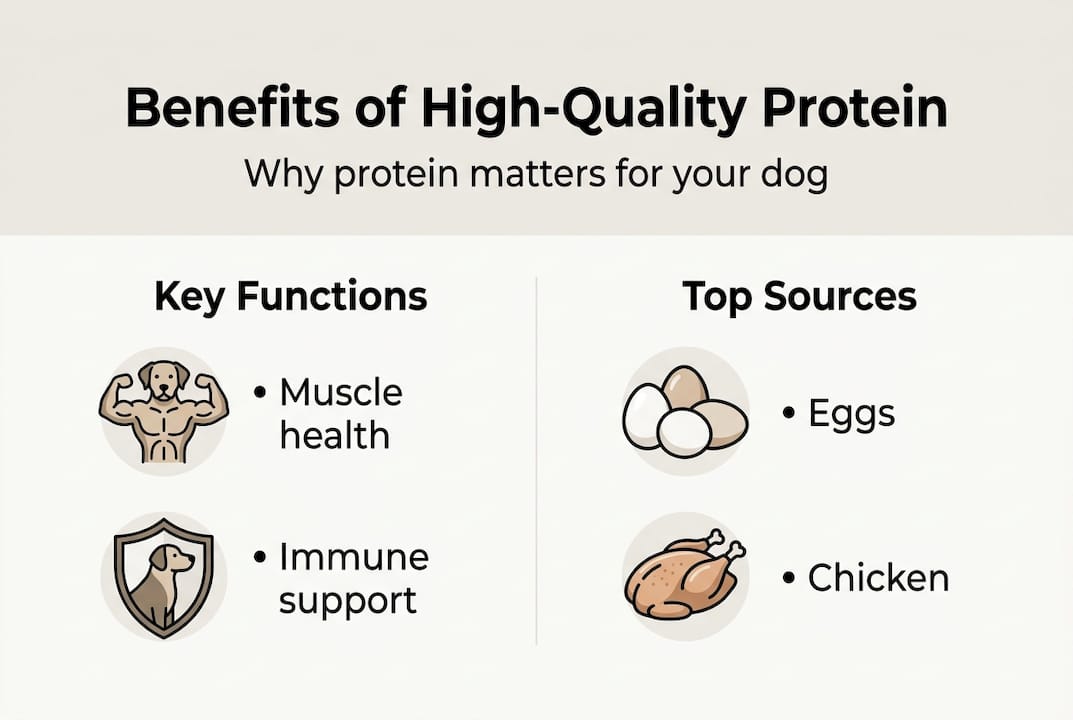
Immune system strength is another major benefit. Antibodies, enzymes, and immune cells are all made from protein. A dog eating low-quality, poorly digestible protein may technically meet minimum protein requirements but still fall short on the amino acids needed to keep the immune system running well.
Skin and coat health improve noticeably when protein quality goes up. Keratin, the structural protein in fur, requires specific amino acids to form properly. Dogs eating high-digestibility proteins often show shinier coats and less shedding within weeks.
Here is a summary of the key health benefits:
Lean muscle development and preservation across all life stages
Stronger immune response and faster recovery from illness
Healthier skin barrier and improved coat condition
Better energy levels from efficient nutrient absorption
Longer, more active life supported by protein for dog longevity
Activity level and life stage matter a lot here. Protein for active dogs needs to be higher in both quantity and quality compared to a sedentary adult. Puppies need more protein for growth, and senior dogs need highly digestible protein to compensate for reduced absorption efficiency.
Quality over quantity. More protein from fillers and low-digestibility sources is not actually better. Your dog needs complete, absorbable protein, not just a high number on the label.
The health impact of high protein is most meaningful when the protein comes from whole, named animal sources. That is where the real difference shows up in your dog’s energy, coat, and vitality.
Eggs as a benchmark illustrate this perfectly. Their near-perfect digestibility and complete amino acid profile explain why they are used as the reference point for measuring all other proteins.
How to read dog food labels for protein quality
Knowing the health benefits, you may wonder how to ensure your dog’s food actually delivers on protein quality. The label is your first tool, and once you know what to look for, it becomes much easier to separate quality from clever marketing.
AAFCO and FEDIAF minimums set the floor: adult dogs need at least 18-21% crude protein on a dry matter basis, while puppies and pregnant or nursing dogs need 22.5-25%. These minimums matter, but they do not guarantee quality. A food can meet the minimum using low-digestibility protein sources and still pass regulatory standards.
Here is how to evaluate a label step by step:
Check the first ingredient. It should be a named animal protein like chicken, beef, salmon, or turkey. Vague terms like “meat” or “poultry” are red flags.
Look for the AAFCO nutritional adequacy statement. This tells you the food meets minimum standards for your dog’s life stage, which is a baseline you want confirmed.
Scan for protein splitting. Some manufacturers list multiple forms of the same low-quality ingredient (like pea protein, pea flour, and pea starch separately) to push them lower on the list while a named meat appears first.
Avoid generic by-products. “Meat by-products” without a named species are harder to evaluate for quality. Named by-products like “chicken liver” are actually nutritious and acceptable.
Check for AAFCO protein standards compliance language and understand what it means for your dog’s specific needs.
Useful things to look for and avoid:
Look for: Named meats first, organ meats listed specifically, short ingredient lists
Avoid: “Meat meal” without a species name, corn gluten meal as a primary protein, excessive fillers
Pro Tip: Cross-reference the guaranteed analysis with the ingredient list. If the protein percentage is high but the first few ingredients are grains or unnamed meals, that protein number is not coming from quality sources. Understanding protein’s role in nutrition helps you ask the right questions when comparing foods.
A good resource for understanding what each ingredient means is the A-to-Z guide on pet food proteins, which breaks down named meats and by-products clearly. You can also explore nutrient-rich dog food comparisons to see how different formulas stack up.
Why most protein advice for dogs gets it wrong
Most mainstream dog food marketing focuses on one number: the crude protein percentage. A bag that says 32% protein sounds impressive, but that figure tells you nothing about where the protein came from or how much of it your dog can actually use. This is where a lot of well-meaning dog owners get misled.
The uncomfortable truth is this: only complete, digestible proteins count. A food with 28% protein from named chicken and eggs will outperform a 35% protein food built on pea protein and unnamed meat meals every single time.
There is also a persistent myth that high-protein diets harm senior dogs. The evidence does not support this for healthy dogs. What matters is quality over quantity, and senior dogs often need higher-quality protein precisely because their digestive efficiency declines with age.
We believe the real standard should be digestibility and amino acid completeness, not the percentage on the label. Eggs and named animal meats set the industry benchmark for a reason. When you focus on why protein quality matters rather than chasing high percentages, you make choices that genuinely support your dog’s health and longevity.
Premium protein solutions for your dog’s health
If you are ready to move beyond guesswork and give your dog protein that truly delivers, Loyal Saints Pets makes that step easy. Our freeze-dried foods are built around named, whole animal proteins that meet the quality benchmarks covered in this guide, with no fillers, no ambiguous by-products, and no additives standing between your dog and real nutrition.
Freeze-drying preserves the natural amino acid profile and digestibility of freeze-dried proteins, so your dog gets the same nutritional integrity as fresh food with the convenience of shelf-stable storage. Every formula meets AAFCO standards and is crafted from human-grade ingredients your dog can actually thrive on. Explore our full range of premium dog protein options and find the right fit for your dog’s life stage, activity level, and taste preferences. More tail wags are coming.
Frequently asked questions
What are the best high-quality protein sources for dogs?
Eggs, chicken, beef, fish, turkey, and lamb are the top natural protein sources for dogs because they provide complete amino acids and superior digestibility that supports every system in your dog’s body.
How can I tell if a dog food has high-quality protein?
Look for a named animal protein as the first ingredient and an AAFCO nutritional adequacy statement. The A-to-Z guide on proteins explains how to evaluate specific ingredients and avoid generic by-products that reduce overall quality.
Is plant protein good for dogs?
Plant proteins like pea and soy can supplement a dog’s diet but should not replace animal proteins. They have lower DIAAS scores and incomplete amino acid profiles that make them less effective as a primary protein source for dogs.
What is the recommended protein percentage for dogs?
Adult dogs need a minimum of 18-21% crude protein on a dry matter basis, while puppies and active dogs need more. AAFCO and FEDIAF guidelines set these minimums, though quality matters as much as the percentage.
Can high protein intake harm my dog?
High-protein diets are safe for most healthy dogs and support muscle, immunity, and energy. Dogs with kidney disorders should have their protein intake tailored under veterinary guidance to ensure the protein is high-quality and appropriately portioned.
Recommended
Comments