.png)
Why whole ingredients in dog food improve your dog's health
- wix mentor
- 5 hours ago
- 9 min read

TL;DR:
Many pet owners mistakenly believe that “all-natural” and “whole ingredients” labels automatically ensure better nutrition for their dogs. However, understanding the actual meaning of whole ingredients, their digestibility benefits, and the importance of nutritional completeness is essential for making informed choices. Choosing foods that combine recognizable whole ingredients, minimal processing, and verified compliance with AAFCO standards supports your dog’s long-term health and vitality.
You might already scan pet food labels looking for terms like “whole ingredients” or “all-natural,” trusting that these claims automatically mean your dog is eating better. The truth is a little more complicated, and understanding the difference can genuinely change your dog’s energy, digestion, and long-term health. This guide breaks down what whole ingredients actually are, how they affect digestion and nutrition, and what you need to watch for so your dog gets real, lasting benefits from every bowl.
Table of Contents
Key Takeaways
Point | Details |
Whole ingredients support gut health | Diets with whole ingredients can improve your dog’s digestion and stool quality. |
Completeness matters most | A healthy dog diet must meet nutritional standards, not just include whole ingredients. |
Consider individual dog needs | Always match food type to your dog’s age, health condition, and sensitivities. |
Processing level adds nuance | Understand the difference between ingredient source and how food is processed. |
What does ‘whole ingredients’ actually mean?
With the myth addressed, let’s clarify what “whole ingredients” really means for your dog’s bowl.
When a dog food brand uses the phrase “whole ingredients,” they typically mean that the food contains recognizable, unrefined components — think whole chicken, whole blueberries, sweet potatoes, or brown rice — rather than fractions or byproducts derived from those sources. Whole chicken means the full muscle meat, skin, and bone used as a complete food source. A “chicken meal,” by contrast, is rendered and concentrated. Both can be nutritious, but they are very different in form and how your dog’s body processes them.
Understanding related claims on the label matters just as much. “Minimally processed” refers to how the ingredients were handled during manufacturing, while “whole ingredients” refers to what those ingredients actually are. Freeze-drying, for example, is a form of minimal processing in pet food that preserves the nutritional profile of whole ingredients without cooking away vital enzymes and nutrients. Ultra-processed pet foods, on the other hand, often use multiple refining steps, high heat, and synthetic additives to compensate for lost nutritional value.
Common whole ingredients found in premium dog foods include:
Whole proteins: Chicken, beef, turkey, salmon, lamb
Whole vegetables: Sweet potatoes, peas, carrots, spinach
Whole fruits: Blueberries, cranberries, apples (without seeds)
Whole grains or grain-free alternatives: Brown rice, oats, or chickpeas
Here is where many owners run into confusion. A bag might feature images of fresh vegetables and lean meat on the front while the ingredient list tells a different story. That gap between marketing and reality is exactly why reading the full ingredient panel matters.
As a study on whole vs. processed ingredients notes, “whole ingredient can be confused with minimally processed, and both claims should be evaluated alongside formulation completeness and tolerance.” This is a critical reminder that no single label term tells the whole story.
Reading about minimally processed dog foods alongside ingredient sourcing gives you a much fuller picture of what your dog is truly eating.
Digestibility and stool quality: The science behind the benefits
Now that we know what whole ingredients are, let’s explore the tangible digestive health benefits they offer your dog.

One of the clearest, most measurable advantages of feeding whole ingredient foods is improved digestibility. Digestibility refers to how efficiently your dog’s body can absorb the nutrients from food. A highly digestible food means less waste, better nutrient uptake, and often noticeably firmer, smaller stools. If you’ve ever switched your dog to a higher-quality food and noticed the change in their bathroom habits, that’s digestibility at work.
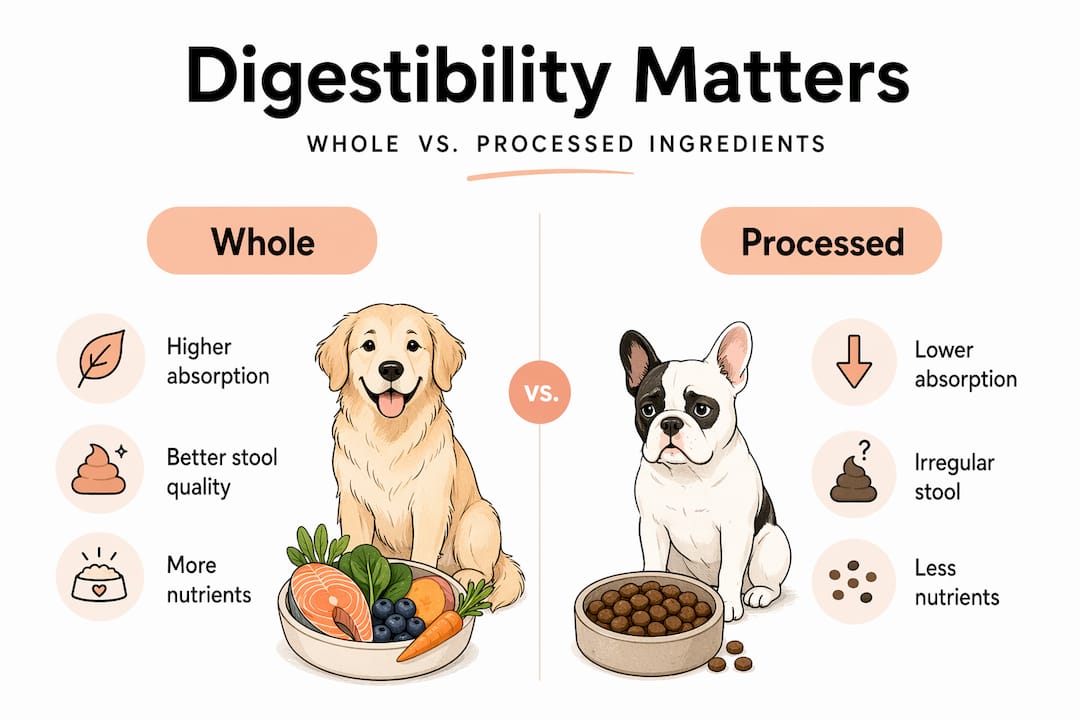
Research consistently supports this connection. Fresh dog foods tend to be more digestible than dry or canned options, with real benefits for gut health and stool quality. Gut-health-focused diets have also shown improved digestibility coefficients and better energy availability compared to control diets, meaning your dog actually uses more of what they eat.
Here’s a straightforward comparison of how different food types generally perform:
Food type | Estimated digestibility | Stool consistency | Nutrient retention |
Freeze-dried whole ingredient | 85 to 95% | Firm, small volume | Very high |
Fresh/refrigerated whole ingredient | 80 to 90% | Firm to normal | High |
Traditional dry kibble | 60 to 75% | Variable, higher volume | Moderate |
Canned wet food | 70 to 80% | Soft to normal | Moderate to high |
These ranges are estimates based on published research trends, not guarantees for every brand or formula. But the pattern is clear: foods built from recognizable, minimally processed whole ingredients tend to support better digestion.
A healthy gut does far more than process food efficiently. The gut microbiome — the community of bacteria living in your dog’s digestive tract — influences immune function, mood, skin health, and even joint inflammation. Supporting it with high-quality, whole ingredient nutrition is one of the most direct investments you can make in your dog’s whole ingredient benefits and overall vitality.
Pro Tip: When switching to a whole ingredient or freeze-dried food, transition gradually over 7 to 10 days by mixing increasing amounts of the new food with the old. This gives your dog’s gut bacteria time to adjust and prevents loose stools during the change.
You can read more about the real benefits for dogs that come from shifting to whole ingredient nutrition, including changes in coat quality, energy levels, and long-term health markers.
Are whole ingredients always nutritionally complete?
Digestive benefits are important, but is a whole-ingredient diet automatically complete and balanced? Let’s set the record straight.
This is one of the most important nuances for any health-focused dog owner to understand. A food can be packed with beautiful, recognizable whole ingredients and still fall short of giving your dog everything they need to thrive. Nutritional completeness is a separate requirement from ingredient quality, and it’s regulated independently.
In the United States, the Association of American Feed Control Officials (AAFCO) sets the nutritional standards that commercially sold dog foods must meet to be labeled as “complete and balanced.” These standards define minimum and sometimes maximum levels of protein, fat, vitamins, and minerals based on a dog’s life stage. A food meeting AAFCO guidelines for adult maintenance, for example, must hit specific targets for calcium, phosphorus, vitamin D, and dozens of other nutrients.
As AAFCO completeness guidelines make clear, “whole ingredients are not automatically ‘better’ if the overall diet is not nutritionally adequate; AAFCO’s completeness is a separate requirement.” A diet made entirely from whole foods could still be deficient in zinc, vitamin E, or omega-3 fatty acids if the formulation doesn’t specifically account for those gaps.
Here’s how different food scenarios can stack up in terms of completeness:
Diet type | Whole ingredients? | AAFCO compliant? | Nutritionally balanced? |
Premium freeze-dried, formulated brand | Yes | Yes | Yes |
Homemade raw with no supplementation | Often yes | Rarely | Often no |
Traditional kibble with fillers | Partially | Usually yes | Usually yes |
Boutique whole food diet, unformulated | Yes | Not guaranteed | Not guaranteed |
The table above shows a pattern you might not expect: homemade diets built from whole, fresh foods are actually among the most likely to miss nutritional targets because most owners don’t have access to veterinary nutritionist guidance.
Here’s how you can check whether a commercial food is nutritionally complete:
Look for the AAFCO nutritional adequacy statement on the label. It should say something like “complete and balanced for adult maintenance” or “all life stages.”
Check whether the statement is based on formulation or feeding trials. Feeding trials are the gold standard.
Look for a named manufacturer or contact information so you can ask about testing if needed.
Cross-reference the ingredient list with the guaranteed analysis panel to confirm protein, fat, and fiber levels align with your dog’s needs.
Consult your vet if you’re ever unsure whether a specific food covers your dog’s life stage, size, or health requirements.
Supporting your dog’s lifelong health means choosing foods that combine whole ingredient quality with verified nutritional adequacy. Reading labels with both criteria in mind is the smartest habit you can build. You can learn more about whole food nutrition to understand how properly formulated diets work together to cover all the nutritional bases.
Nuances and exceptions: Is whole ingredient always best for every dog?
Despite the overall advantages, there are situations where prioritizing whole ingredients requires extra caution.
Most healthy adult dogs thrive on well-formulated, whole ingredient diets. But every dog is an individual, and some situations call for a more tailored approach. Knowing when whole ingredient foods are the clear winner and when a specialized formula might serve your dog better is part of being a truly informed pet owner.
Some dogs with certain medical conditions or sensitivities may actually do better on specific commercial formulas, and diet choices should always consider the dog’s overall health condition. This isn’t a reason to avoid whole ingredients altogether. It’s a reminder to work with your vet rather than relying solely on label claims.
Situations where you should proceed carefully or consult a vet before switching to a whole ingredient diet:
Dogs with kidney disease: Certain proteins and phosphorus levels in whole ingredient diets may need strict management.
Dogs with pancreatitis: Fat content in rich, whole ingredient formulas may be too high during flare-ups.
Dogs with food allergies or intolerances: Some whole ingredient foods contain common allergens like chicken, beef, or certain fruits. A limited-ingredient diet with novel proteins may be more appropriate.
Puppies with specific breed needs: Large breed puppies, in particular, have specific calcium-to-phosphorus ratios that must be tightly controlled to support healthy bone development.
Dogs on prescription diets: Veterinary therapeutic diets are formulated for specific conditions and should not be swapped without professional guidance, even for a premium whole ingredient option.
Pro Tip: Before switching your dog to any new food, including a whole ingredient or freeze-dried option, have a conversation with your vet. A quick check of your dog’s current bloodwork and health history can confirm whether a whole ingredient diet is appropriate or whether adjustments are needed.
Understanding why feeding whole ingredients matters for vitality also means accepting that “whole” is not a one-size-fits-all answer. Context always matters.
Our perspective: What most articles miss about whole ingredient diets
Most articles on this topic end up saying the same thing: whole ingredients are great, look for the AAFCO statement, ask your vet. All of that is true, but it skips over some of the more honest and practical realities that dog owners face when actually choosing a food.
The biggest blind spot in the conversation is the tendency to apply human food logic directly to pet food. The ultra-processed food (UPF) framework has genuinely transformed how many people think about their own diet. But dogs are not humans. Their digestive systems, their caloric needs, and the way their bodies use nutrients differ in fundamental ways. A dog eating a food that scores poorly by a human UPF rubric might still be thriving, while a dog eating what looks like a pristine whole ingredient diet could be developing a mineral deficiency. Evidence-based criteria specific to canine nutrition always matter more than borrowed human food philosophy.
We’ve also noticed that “whole ingredients” has become a marketing phrase as much as a factual claim. Brands know that health-conscious owners respond to it, so it ends up on packaging that doesn’t fully back up the promise. That’s why we believe in looking past the front of the bag entirely and going straight to the guaranteed analysis, the AAFCO statement, and the sourcing information.
The most meaningful insight from years of thinking about canine nutrition is this: the intersection of whole ingredients, minimal processing, and verified nutritional completeness is where the real results live. Any one of those three factors in isolation is not enough. The benefits of minimally processed pet food are well supported, but they compound significantly when the food is also built from whole, traceable ingredients and formulated to meet AAFCO standards.
Trust labels that show you all three. And when in doubt, your vet is always the right first call.
Explore premium, whole ingredient freeze-dried options for your dog
If you’ve worked through this guide and you’re ready to find a food that genuinely checks all the boxes, whole ingredients, minimal processing, and verified nutritional completeness, you’re in the right place.

At Loyal Saints, every product we offer is built from human-grade, whole ingredients that are freeze-dried to lock in freshness without additives or fillers. Our formulas meet AAFCO standards for complete and balanced nutrition, so you’re not choosing between quality ingredients and proper nutrition. You get both. Discover the benefits of freeze-dried dog food and see how this method of preservation keeps whole ingredients at their most nutritious. When you’re ready, browse our whole ingredient dog food options and find the right fit for your dog’s age, size, and health goals. More tail wags are coming.
Frequently asked questions
What makes whole ingredients better than processed ingredients for dogs?
Whole ingredients are often more digestible and may support better gut health and stool quality, but they only deliver full benefits when part of a diet that is also nutritionally complete and balanced for your dog’s life stage.
Does whole ingredient pet food guarantee my dog’s diet is complete?
No. Completeness depends on meeting standards like those set by AAFCO, not on ingredient type alone, so always check the nutritional adequacy statement on the label.
Can dogs with sensitive stomachs or medical issues eat whole ingredient foods?
Some dogs with sensitivities or medical needs may require specialized commercial diets, and because diet choice should reflect the dog’s condition, always consult your vet before making any switch.
Is minimally processed food the same as whole ingredient food?
No. “Minimally processed” describes how the food is made, while “whole ingredient” describes what is in it, and as research confirms, both claims should be evaluated together alongside overall formulation completeness.
Recommended