.png)
Step by Step Dog Feeding Guide for Healthy Dogs
- wix mentor

- 6 hours ago
- 8 min read
TL;DR:
Feeding your dog correctly depends on understanding their individual needs based on age, weight, and activity level. Proper portion control, regular meals, and gradual food transitions support optimal health and prevent overfeeding or underfeeding. Consistent routines, accurate measurements, and monitoring your dog’s condition are essential for safe and nutritious feeding habits.
Feeding your dog sounds simple until you realize you might be doing it wrong. How much is too much? How often is too little? A proper step by step dog feeding guide answers these questions in a way that generic bag instructions never will. Most owners either overfeed based on package charts or underfeed because they eyeball portions. The result is a dog who is overweight, lethargic, or constantly begging at the bowl. This guide walks you through every stage of the feeding process so you can give your dog exactly what they need to thrive.
Table of Contents
Key takeaways
Point | Details |
Know your dog’s individual needs | Age, weight, breed, and activity level all determine how much and how often to feed. |
Weigh food, don’t guess | Using a kitchen scale beats measuring cups for accurate portion control every time. |
Twice daily is the standard | Most adult dogs do best with two meals per day to support digestion and mood. |
Life stage changes everything | Puppies, adults, and seniors each need different meal frequencies and nutrient profiles. |
Package charts are starting points | Adjust based on body condition score, not just the numbers on the bag. |
Your step by step dog feeding guide starts here
Before you scoop a single cup of kibble, you need to understand what your specific dog actually requires. A young Border Collie running trails with you burns far more calories than a middle-aged Basset Hound who naps most of the day. That difference matters enormously when you sit down to plan a stepwise dog meal plan that works.
Assess your dog’s individual factors
Start by noting these key details about your dog:
Age and life stage: Puppy, adult (1 to 7 years), or senior (7 years and older)
Weight and breed size: Toy, small, medium, large, or giant breed
Activity level: Low, moderate, or high exercise daily
Health status: Any medical conditions like kidney disease, diabetes, or allergies
Spayed or neutered status: This lowers calorie needs by roughly 20 to 30 percent
Once you have these facts written down, you can move to the next step with confidence rather than guesswork.
Gather your tools and read the label
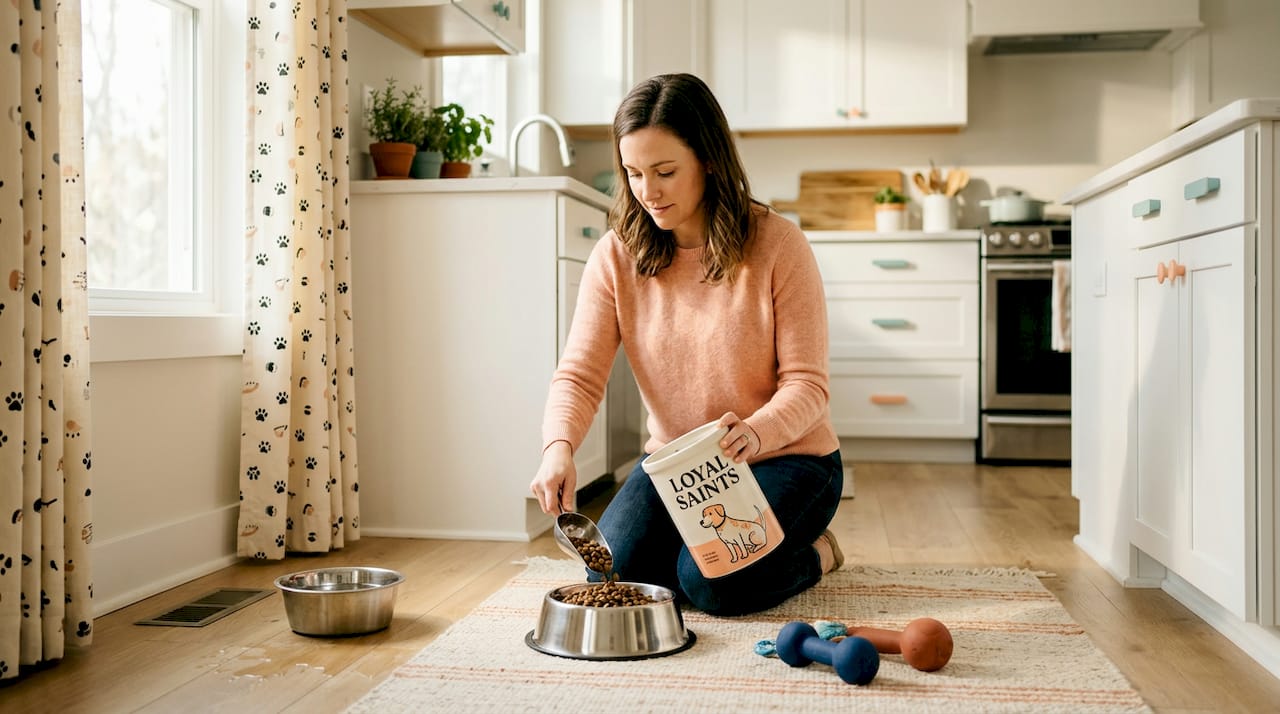
Good dog feeding instructions begin with the right equipment. You will need a calibrated kitchen scale, a set of measuring cups, and an appropriate sized bowl for your dog’s breed. A stainless steel dog bowl that sits deep enough to hold portions without spilling works well for most sizes.
Next, study the pet food label carefully. Look for the phrase “Complete and Balanced” on the packaging. This means the food meets AAFCO nutritional standards for your dog’s life stage. You also want to check the feeding guidelines on the back, though treat those numbers as a starting range rather than a fixed rule. Individual dog metabolism can vary by as much as 30%, so the chart on the bag is simply a first draft.
Pro Tip: Ask your veterinarian to assess your dog’s body condition score (BCS) on a scale of 1 to 9. A score of 4 to 5 is ideal. This score becomes your most reliable guide for adjusting portions up or down.
How to feed a dog: the step-by-step process
Now for the core of this guide. These steps apply to most adult dogs and can be adjusted for puppies and seniors in the next section.
Calculate your dog’s daily calorie needs. A general starting formula for adult dogs is to find their Resting Energy Requirement (RER): multiply their body weight in kilograms to the power of 0.75, then multiply by 70. For a moderately active adult dog, multiply the RER by 1.6. For a spayed or neutered adult with low activity, use 1.2 instead. These are estimates. Your vet can refine them.
Divide daily calories into two meals. Veterinarians recommend twice daily feeding for adult dogs to stabilize blood sugar and support healthy digestion. Split the total daily amount roughly in half.
Set consistent feeding times. The best times for adult dogs are early morning, between 6 and 8 AM, and early evening, between 5 and 7 PM. Consistent feeding times reduce anxiety and help regulate your dog’s digestive rhythm.
Weigh the food, then serve. Do not rely on volume measurements alone. Kibble density varies between brands, so a full cup of one food may contain 100 more calories than the same volume of another. Use your kitchen scale in grams for precision.
Prepare the food type correctly.
Food Type | Preparation Notes | Serving Tip |
Dry kibble | No prep needed | Weigh in grams; serve at room temperature |
Wet or canned | Refrigerate after opening | Warm slightly if your dog prefers it |
Freeze-dried | Rehydrate with water | Mix with warm water 3 to 5 minutes before serving |
Raw | Thaw in refrigerator overnight | Serve cold; avoid microwaving to preserve nutrients |
Introduce new foods gradually. When switching brands or food types, mix the new food with the old over 7 to 10 days. Start with 25% new and 75% old, then shift the ratio every few days. Gradual dietary transitions reduce digestive upset significantly. You can follow a structured nutrition transition guide if you are switching to freeze-dried food for the first time.
Account for treats in the daily total. Treats count toward daily calories and ignoring them is one of the most common ways owners accidentally overfeed. If you give treats during training, reduce the meal portion slightly that day.
Pro Tip: Use your dog’s portion calculator to get a precise starting amount based on body weight and condition score. Then monitor your dog’s weight weekly for the first month and adjust by 10% increments as needed.
Common feeding mistakes to avoid
Even owners who care deeply about their dogs make these errors regularly. Knowing them helps you course-correct before they affect your dog’s health.
Relying solely on package charts. Those numbers are averages for an average dog. Your dog may need significantly more or less depending on metabolism and activity. Feeding chart guidelines are starting points, not prescriptions.
Free-feeding all day. Leaving food out constantly makes it nearly impossible to monitor intake. Free-feeding increases obesity risk and can cause anxious, food-obsessed behavior. Scheduled meals give you control.
Skipping meals to “make the dog hungrier.” Long gaps between meals cause stomach acid buildup. This leads to bile vomiting, especially in the early morning. Twice daily feeding reduces bile vomiting and GI upset in most dogs.
Feeding right before vigorous exercise. For large breeds especially, exercising too soon after eating raises the risk of bloat and gastric dilatation-volvulus (GDV), a life-threatening condition. Wait at least one hour after meals.
Ignoring changes in appetite. If your dog suddenly eats less, more, or shows signs of discomfort after eating, that signals a problem. Weight loss, persistent vomiting, or dramatic hunger behavior are all reasons to call your vet.
Sudden changes in eating habits are often the first sign of an underlying health issue. Do not wait weeks to see if it resolves. Contact your veterinarian if changes last more than two to three days.
For a deeper look at where owners go wrong, the 7 common dog feeding mistakes resource covers each pitfall with practical fixes.
Feeding puppies, adults, and seniors differently
A puppy feeding schedule looks nothing like an adult dog’s routine, and a senior dog’s needs shift again. Here is how feeding changes across life stages.
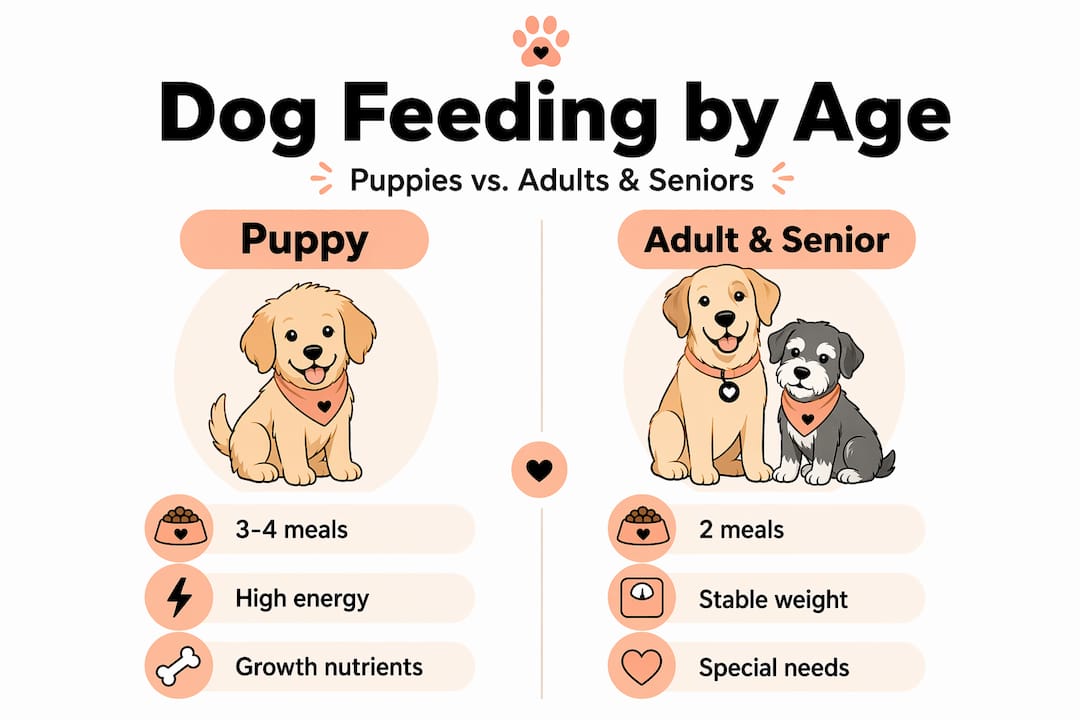
Life Stage | Meals Per Day | Key Nutritional Focus | Special Considerations |
Puppy (under 6 months) | 3 to 4 meals | High protein, DHA, calcium for growth | Small stomachs need smaller, frequent meals |
Puppy (6 to 12 months) | 2 to 3 meals | Continued growth support | Monitor weight; avoid overfeeding large breeds |
Adult (1 to 7 years) | 2 meals | Maintenance calories, balanced macros | Adjust for activity and reproductive status |
Senior (7 years and up) | 2 to 3 meals | Joint support, digestibility, lower calories | Softer food may help dogs with dental issues |
Puppies require 3 to 4 small meals daily until at least 6 months old. Their energy demands are high, their stomachs are small, and skipping meals can cause blood sugar drops that affect development. A puppy feeding schedule built around consistent mealtimes sets behavioral habits that carry into adulthood.
Adult dogs transition well to two meals a day. This schedule supports digestion, keeps behavior predictable, and makes it easy to monitor intake. Senior dogs often benefit from returning to three smaller meals if they have slower digestion, reduced appetite, or conditions like arthritis that affect mobility around mealtimes.

If you want to build a best dog food guide specific to your dog’s life stage, the natural dog nutrition guide at Loyalsaintspets walks through each phase with practical recommendations.
My honest take on feeding frequency and portioning
I have talked with hundreds of dog owners over the years, and the single most common mistake I see is treating the feeding bag like a rulebook. It is not. It is a suggestion from a company that does not know your dog.
What I have learned is that twice-daily feeding is genuinely one of the best things you can do for your dog’s gut health and mood. Dogs fed twice a day are calmer at mealtimes and less likely to develop the anxious food-guarding behavior that once-daily feeding can create. The science backs this up, but honestly, you can see the difference in your dog within a few weeks of switching.
I have also seen owners add a quality daily supplement like a canine multivitamin to fill nutritional gaps, especially when transitioning between food types. That kind of attention to detail makes a real difference over the long term.
The part most guides skip is this: feeding is not just about calories. It is about routine, trust, and the signal you send your dog every single day that they are cared for. A consistent feeding schedule reduces anxiety, supports gut health, and honestly makes your dog easier to live with. That is worth more than any perfect formula.
— Eyo
Feeding your dog better starts with better food
You have the knowledge. Now the food in the bowl has to match the effort you are putting in.
At Loyalsaintspets, the feeding philosophy behind this guide is built into every product. The freeze-dried food range uses human-grade proteins, whole fruits, and vegetables with no fillers or artificial additives. Every formula meets AAFCO standards for complete and balanced nutrition across life stages. If you are ready to move beyond processed kibble, learn why freeze-dried food supports better digestion, coat health, and energy than conventional options. When you are ready to make the switch, browse the full shop and find the right formula for your dog’s age, size, and needs. More tail wags are coming.
FAQ
How many times a day should I feed my adult dog?
Most adult dogs do best with two meals per day, ideally in the early morning and early evening. This schedule supports stable blood sugar and healthy digestion, and reduces the risk of bile vomiting from long fasting periods.
How do I know if I am feeding my dog the right amount?
Use your dog’s body condition score as your primary guide. A score of 4 to 5 on a 9-point scale indicates a healthy weight. If you can feel the ribs without pressing hard but cannot see them, your dog is likely at an ideal weight.
Can I follow the feeding instructions on the dog food bag?
Package feeding guidelines are useful as a starting point only. Individual metabolism can vary by up to 30%, so you should monitor your dog’s weight and adjust portions based on body condition rather than relying solely on the chart.
When should puppies transition to adult feeding schedules?
Most puppies can move from 3 to 4 meals per day down to 2 meals per day around 6 to 12 months of age, depending on breed size. Large breeds generally benefit from staying on more frequent, smaller meals longer to reduce bloat risk.
Are treats included in my dog’s daily calorie total?
Yes. Treats count toward your dog’s daily calorie intake and should be factored into your feeding plan. Reduce the meal portion slightly on days when you give treats to avoid accidental overfeeding and weight gain.
Recommended
Comments