.png)
How human-grade ingredients enhance vitality in dog food
- wix mentor

- 4 days ago
- 7 min read
TL;DR:
Human-grade ingredients must meet strict FDA/USDA standards for safety and quality.
Better digestibility and palatability are benefits but require proper formulation and balance.
Choosing a reputable, fully compliant brand ensures genuine standards beyond just marketing claims.
The “human-grade” label on dog food bags is everywhere right now, and it sounds reassuring. But here’s the thing: not every product carrying that claim is actually held to the same standard. Human-grade ingredients must be fit for human consumption, sourced and processed in FDA/USDA-compliant facilities, unlike feed-grade options that follow looser AAFCO pet feed regulations. That distinction matters more than most owners realize. This article breaks down what human-grade really means, what the science says about its benefits, and how to make smart, safe choices for your dog’s long-term health and vitality.
Table of Contents
Key Takeaways
Point | Details |
Human-grade defined carefully | Human-grade ingredients must meet strict FDA/USDA standards, not just marketing claims. |
Digestibility and absorption | These ingredients boost nutrient absorption and gut health if properly formulated. |
Comparison with feed-grade | Feed-grade foods can still be healthy if AAFCO-compliant and well sourced. |
Choose and transition wisely | Verify labels, consult your vet, and transition slowly to new foods for best results. |
Understanding human-grade ingredients in dog food
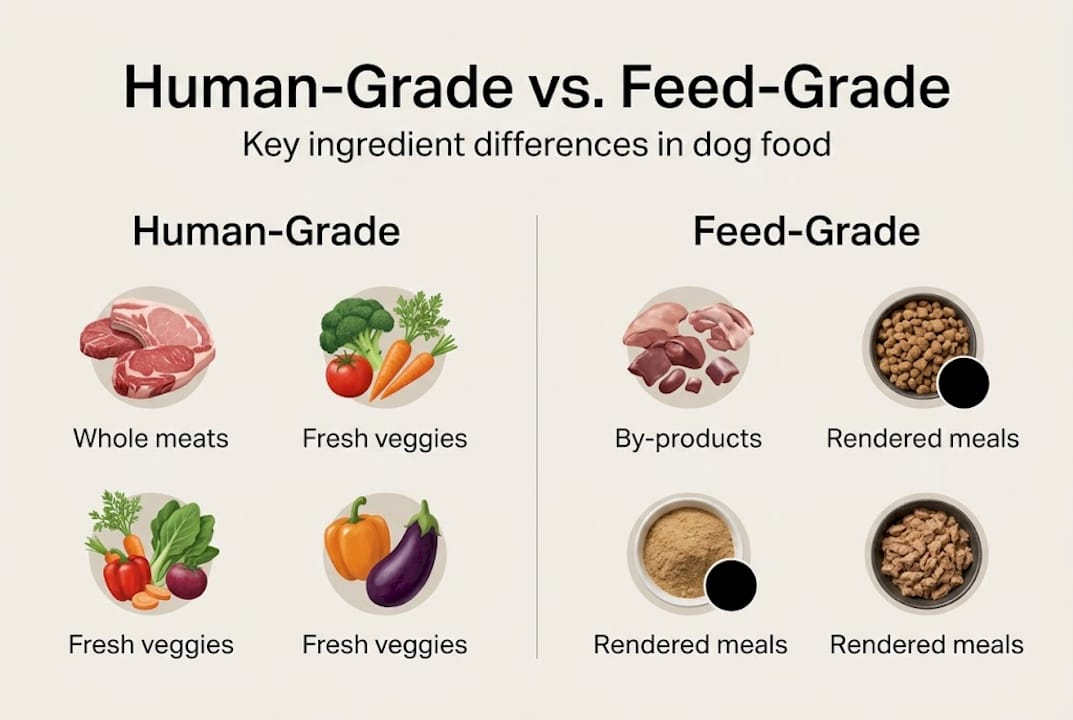
So what does “human-grade” actually mean in a legal and practical sense? According to FDA/USDA standards, an ingredient qualifies as human-grade only when it is fit for human consumption and handled entirely within facilities that meet human food safety requirements. That’s a much higher bar than most pet food ingredients are held to.
Feed-grade, by contrast, follows AAFCO pet feed regulations. These allow by-products, rendered meals, and ingredients that would not pass muster in a human food facility. Understanding the feed-grade vs human-grade difference helps you read labels with far more confidence.
Here’s where it gets tricky. The term “human-grade” is not officially regulated by the FDA when used on pet food packaging. A brand can print it on a bag without every ingredient meeting the true standard. That means you need to go beyond the label and look at the ingredient verification process a brand uses.
Also important: human-grade ingredients do not automatically equal a complete and balanced diet. AAFCO compliance for nutritional completeness is a separate requirement entirely.
What makes an ingredient truly human-grade?
Sourced from facilities registered for human food production
Processed under FDA or USDA oversight
Free from feed-grade by-products and rendered meals
Traceable from farm or supplier to finished product
Handled with no cross-contamination from feed-grade materials
Keeping this checklist in mind helps you cut through marketing language and focus on what actually protects your dog.
Digestibility, absorption, and palatability: Core benefits explained
Once you know what human-grade means, the next question is whether it makes a real, measurable difference in your dog’s health. The short answer is yes, especially when it comes to how well your dog digests and absorbs nutrients.
Less processing is the key factor. Human-grade ingredients go through fewer industrial steps, which means more of the original nutrients stay intact. Studies show up to 40% better digestibility compared to standard kibble, and stool volume can be reduced by up to 66%. Smaller stools are actually a reliable sign that your dog’s body is using more of what it eats.
Metric | Human-grade food | Conventional kibble |
Digestibility | Up to 40% higher | Baseline |
Stool volume | Up to 66% less | Baseline |
Nutrient retention | Higher (less processing) | Lower |
Palatability | Generally higher | Variable |
For picky eaters or dogs with sensitive stomachs, palatability is a big deal. Real, recognizable ingredients simply taste better to most dogs. Owners often notice their dog finishing meals more consistently and showing more enthusiasm at feeding time.
Stat to know: Human-grade dog food can reduce stool volume by up to 66%, which reflects how efficiently your dog is absorbing nutrients rather than passing them as waste.
Vets generally support human-grade options when the product carries an AAFCO complete and balanced label. The human-grade food benefits are most reliable when the formula is properly designed, not just when the ingredients sound impressive.
Pro Tip: If your dog has a sensitive stomach or a history of food sensitivities, a human-grade, minimally processed food is often the first dietary change a vet will recommend. Always confirm the AAFCO label before switching.
Human-grade vs. feed-grade: What actually matters?
With the core benefits clear, it helps to compare human-grade and feed-grade side by side. The differences are real, but so are some common misconceptions.

Feature | Human-grade | Feed-grade |
Ingredient sourcing | FDA/USDA human food facilities | AAFCO pet feed regulations |
By-products allowed | No | Yes |
Processing level | Minimal | Often high |
Traceability | Higher | Variable |
Cost | Higher | Lower |
Nutritional completeness | Depends on formulation | Depends on formulation |
The advantages of human-grade dog food are genuine: better sourcing, fewer questionable by-products, and higher palatability. But here’s the nuance that most marketing glosses over.
Systematic reviews show no definitive proof that human-grade is categorically safer or more nutritious than a well-formulated, regulated feed-grade diet. Processing methods vary widely, and a properly balanced feed-grade product can support a healthy dog just as effectively.
“Benefits like safety and palatability are real, but research is ongoing. No systematic review has confirmed long-term superiority of human-grade over regulated feed-grade when both are properly formulated.”
What this means for you: ingredient grade matters, but formula quality matters just as much. A human-grade product with poor nutritional balance is not better than a carefully formulated feed-grade food. The dog food longevity benefits you’re looking for come from the whole package, not a single label claim.
Common misconceptions worth clearing up:
“Human-grade” on the label does not mean every ingredient meets the standard
Higher price does not always equal better nutrition
Feed-grade is not automatically dangerous or low quality
A complete and balanced AAFCO formula matters more than the grade alone
How to choose human-grade dog food: What every owner should know
Understanding the benefits is valuable, but knowing how to select and introduce the right food is where you actually make a difference in your dog’s daily life. Here’s a practical approach.
Check for AAFCO compliance first. The AAFCO complete and balanced label tells you the food meets minimum nutritional requirements. Prioritize AAFCO compliance over the human-grade claim itself when evaluating a product.
Look for facility certification. Genuine human-grade products are made in FDA- or USDA-registered facilities. Ask the brand directly if this information isn’t on the packaging.
Evaluate traceability. Brands that are serious about quality will tell you where their ingredients come from. Traceability in pet food is one of the strongest signals of a trustworthy product.
Transition gradually. Switching foods too quickly can upset your dog’s digestive system. Move from the old food to the new one over 7 to 10 days, mixing increasing amounts of the new food each day.
Watch for changes. Monitor stool consistency, energy levels, coat quality, and appetite during the transition. These are your best real-world indicators of how well the new food is working.
Consult your vet. Every dog is different. A vet can help you match a food’s formulation to your dog’s specific health needs, age, and activity level. The human-grade impacts on digestion and vitality are most meaningful when the choice fits your individual dog.
Pro Tip: Ask your vet to review the ingredient panel and guaranteed analysis together, not just the marketing claims. A five-minute conversation can save you months of trial and error.
Our take: What health-conscious owners often overlook with human-grade ingredients
We’ve looked at a lot of dog food formulas, and the pattern we keep seeing is this: owners get excited about the “human-grade” label and stop asking questions. That’s where the real risk lies, not in the ingredients themselves, but in the assumption that the label does all the work.
No single ingredient is a miracle. What actually drives long-term vitality is the whole diet: the balance of proteins, fats, and micronutrients, the quality of the formulation process, and the consistency of the sourcing. Human-grade ingredients are a meaningful foundation, but they need to be part of a thoughtfully designed, AAFCO-compliant formula to deliver real results.
As nutrition research confirms, the evidence supports benefits but points to no magic bullet. A dog thriving on a well-balanced diet will always outperform one eating an expensive but poorly formulated food. What we recommend to every owner reading this: look for healthy dog food tips that go beyond grade and focus on transparency, traceability, and nutritional balance. That’s the combination that actually adds years and quality to your dog’s life.
Find the right human-grade nutrition for your dog
You’ve done the research. Now it’s time to put it into practice with a brand that holds itself to the standard you’ve been reading about.

At Loyal Saints, every recipe is built on certified human-grade ingredients, sourced from trusted suppliers and processed with minimal handling to preserve nutritional integrity. Our freeze-dried human-grade food locks in nutrients without additives or fillers, and every formula meets AAFCO complete and balanced standards. Whether you’re switching for the first time or looking for a better option, you can shop human-grade recipes designed with your dog’s vitality in mind. Visit Loyal Saints and find the nutrition your dog deserves.
Frequently asked questions
Are human-grade ingredients always safer for dogs?
Human-grade ingredients offer higher quality sourcing, but safety and nutrition depend on complete and balanced formulation, not the ingredient label alone.
What certification should I look for beyond ‘human-grade’?
Always check for an AAFCO complete and balanced label, and choose brands with FDA- or USDA-registered facilities for true human-grade standards.
Should all dogs switch to human-grade food?
Not necessarily. If your pet thrives on a balanced feed-grade diet, there may be no need to switch. Always consult your vet, since vet guidance confirms human-grade is not inherently superior to quality feed-grade when both are properly balanced.
Is there proof human-grade food extends a dog’s life?
There is no scientific proof that human-grade food guarantees a longer life. Benefits like improved digestion and palatability are more certain, and no long-term superiority has been confirmed in meta-analyses.
Recommended
Comments